

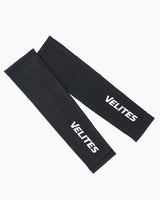
At VELITES , when we start to develop a new product , we always have a very clear premise: either we bring two or three fundamental differences compared to what already exists on the market or the project doesn't move forward. With the knee sleeves something very curious happened: we had to start the project from scratch up to three times. In equipment development it's easy to focus on an initial idea and try to validate it at all costs, but reality (the tests in the box and direct athlete feedback) taught us that we had to change direction.
We were clear the market is saturated with practically identical models. The vast majority simply replicate the classic four-piece knee sleeve design: the front part, the two side panels and a small piece at the rear that tends to accumulate material and create annoying folds when bending the leg. Our goal was to design high-performance equipment for all kinds of athletes.
▼ Index
- 1. What are you putting on your leg? Medical knee braces (Kneepad) vs. Sports knee sleeves (Knee Sleeves)
- 2. The three common problems of traditional knee sleeves
- 3. The VELITES alternative: This is how we design high-performance equipment together with athletes
- 4. The System: How to gain stability without compromising your mobility
- 5. The traffic light of official regulations: CrossFit vs. IWF
- 6. Quick selection guide: Which to choose according to your training
1. What are you putting on your leg? Medical knee braces (Kneepad) vs. Sports knee sleeves (Knee Sleeves)
There is a quite common confusion in boxes when it comes to understanding what function each type of knee sleeve serves.
A medical or orthopedic kneepad (what is internationally known as Kneepad) is designed with a clear purpose: to immobilize and limit movement passively. They usually include metal stays, rigid plastic pieces, patella stabilizers and velcro closures. They are intended for recovery processes or post-operative situations where it is necessary to restrict joint movement. If you try to train CrossFit, HYROX or weightlifting with this type of elements, you will limit your natural range of motion, alter your stride and lose fluidity. In fact, international federations prohibit any type of mechanical insert in competition.
In disciplines like CrossFit, weightlifting or HYROX, sports compression knee sleeves (Knee Sleeves). Their job is not to treat a pathology, but to offer elastic compression, maintain thermal comfort in the joint, provide support and improve proprioception. They give you stability under load and greater safety in the lowest squat positions, while always allowing the knee to move with total freedom.

2. The three common problems of traditional knee sleeves
If we analyze the most common complaints of athletes who train intensely on a regular basis, the limitations of conventional neoprene knee sleeves can be summarized in three concrete points:
Seam failures: Being composed of multiple joined pieces, the seams become zones of high mechanical stress. With continuous use and deep flexions, the material ends up failing at those junction points.
Excessive compression on the calf: The thicker a classic knee sleeve is, the greater the support it offers, yet it excessively presses the upper insertion of the calf and soleus. This tends to compromise blood circulation, accumulates uncomfortable tension in the area and forces the athlete to pull their knee sleeves down constantly during the session to relieve the pressure.
Loss of tension and slipping: Many models on the market have a totally cylindrical shape. The human body is not a straight cylinder: the thigh is wider than the knee and it changes volume when flexed. By not adapting to the anatomy, the knee sleeve tends to move as soon as sweat appears.
Performance differences between materials
3. The VELITES alternative: This is how we design high-performance equipment together with athletes
To solve these shortcomings, we have developed two technological lines adapted to different profiles and training needs: the FLOW range and the POWER range.
Joint compression and thickness guide
FLOW Range (The fabric - textile approach)
These knee sleeves are made with a high-strength elastic fabric that combines 56% nylon, 28% elastodiene, 15.5% polyester and 0.5% elastane.
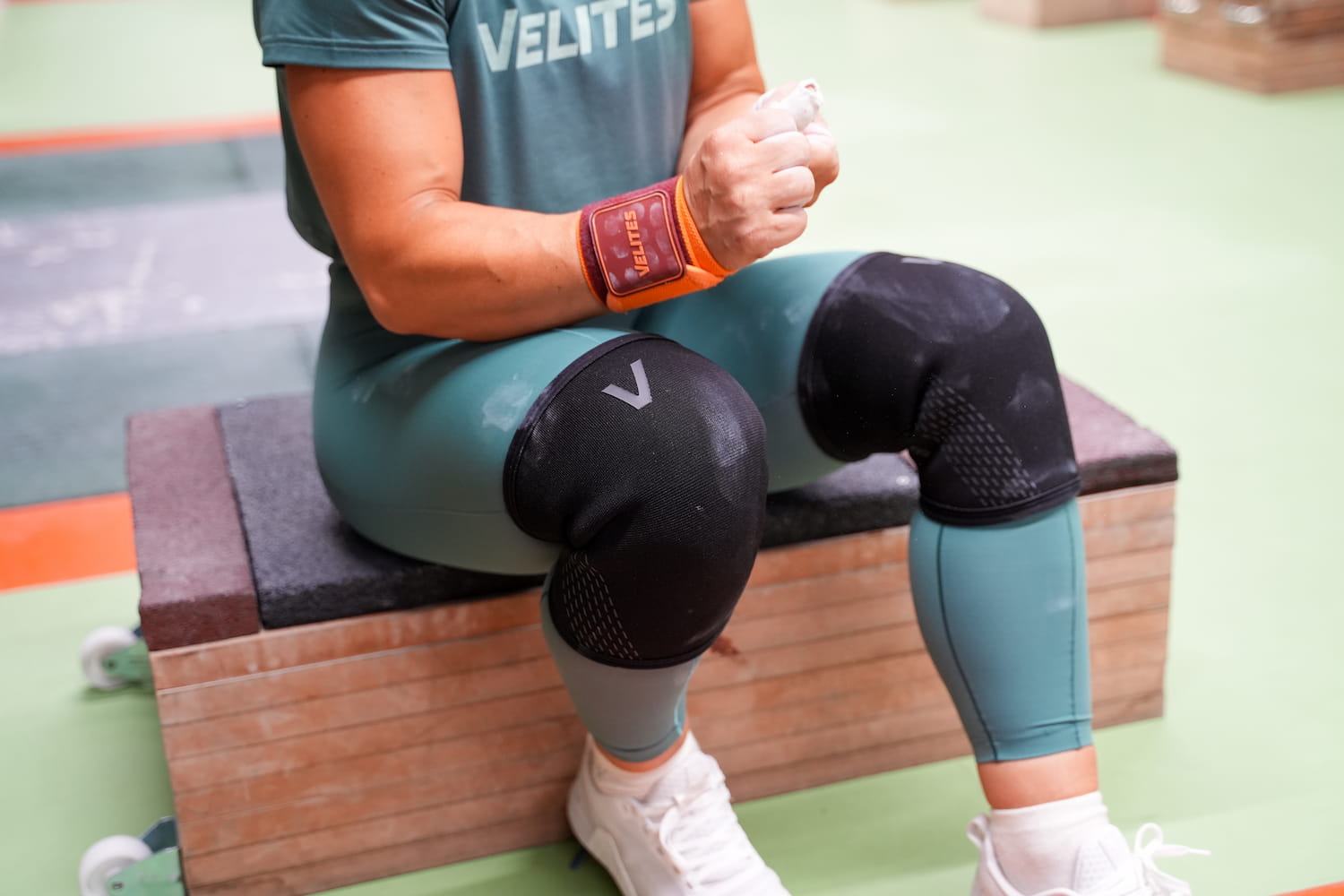
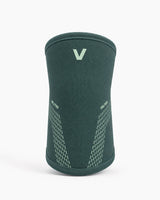
Their design stands out for not being cylindrical; it features an ergonomic shape that considers three different diameters to fit the real anatomy of the leg: a wider upper zone for the thigh, an intermediate area adapted to the patella, and a narrower base. In addition, they incorporate anti-slip silicone bands both on the upper and lower edges, ensuring that the support stays fixed in place whether on skin or over tights.

- CHOOSE YOURS (PRE-SALE) HERE
They come in two distinct versions: Single Layer (a light elastic layer, identifiable by the lighter tone on the upper part) and Double Layer (double layer for intermediate compression, with the darker tone on top).
POWER Range (The neoprene - heavy lifting approach)
In this model we have completely modified the traditional construction. Instead of using only conventional neoprene, the POWER knee sleeves use a sandwich structure.
They feature an internal core of high-density neoprene that provides heat and stability, covered by an outer layer of high-compression fabric that adds extra structural tension. To the touch they offer a much firmer and more compact sensation under load than common neoprene.

To solve the usual problems of durability and comfort, we applied two design improvements:
Calf anti-compression system: We have slightly reduced the length on the lower rear part of the knee sleeve. In this way, the necessary compression on the knee joint is maintained but the pressure on the calf during deep flexions is released, avoiding circulation discomfort. Support in the joint and less pressure in critical areas.
Single-piece construction: We eliminated redundant side panels. The POWER sleeves are structured as a single piece with a single seam at the rear area. This joint is doubly reinforced from the exterior and the interior using a technique inspired by professional surf wetsuits, designed to withstand extreme tensions. The textile reinforcement takes on the stretch tension, protecting the structure and minimizing common failure points.
As a functional feature in the 5mm model, the material's flexibility allows folding the upper flap down to double the padding in the contact area, providing effective relief in direct impact movements such as loaded lunges. For its part, the 7mm model incorporates a printed line pattern that covers most of the surface to provide the maximum level of stability in heavy lifts.

4. The System: How to gain stability without compromising your mobility
The differentiating value of this development lies in the concept of a Modular System under the premise "Adapt your support to your workout". A functional workout or a strength session rarely require the same level of support or mobility in every exercise block.
In classic weightlifting, it has been common practice to place elastic medical bandages under neoprene knee sleeves to seek greater pressure. However, that combination usually causes severe chafing due to constant friction on the skin. Our modular system allows combining textile and neoprene models safely to adjust support exactly to each phase of training.
We propose some examples of how to combine them because we have designed knee sleeves that help both hybrid athletes in CrossFit and HYROX and more specialized weightlifting or powerlifting athletes.
Hack to alternate strength and cardio without wasting time
Here are some examples:
FLOW 1 Layer + POWER 5 mm (Mobility + Smart Support)
This set is designed for hybrid training that combines high-speed exercises (like running, jumps or burpees) with moderate to heavy weight lifts. Running or performing dynamic movements with a rigid 7mm knee sleeve increases joint fatigue unnecessarily.
With this setup, the athlete keeps the FLOW single-layer knee sleeve on during the whole session to ensure thermal comfort and light compression without sacrificing agility.
Meanwhile, the POWER 5mm knee sleeve can be kept rolled down at the ankle or the calf. When the bar strength block arrives (such as sets of Squat Clean or Snatch), the POWER 5mm is pulled up in an instant over the fabric one, providing a higher level of stability to execute the lift with full confidence under load. After finishing, it's lowered again to immediately recover full mobility in the next metabolic block.
FLOW 2 Layer + POWER 7 mm (Maximum Stability and Lock-in)
This combination focuses on maximal strength work, powerlifting, heavy weightlifting or sessions intended to set a new maximum record (RM). The Flow double-layer knee sleeve establishes a very firm and structured compression base on the joint.
By overlapping the 7mm POWER, you obtain a high-stiffness support structure. It is the recommended configuration for those athletes seeking an absolute feeling of fixation in the knee when working with very high load percentages and needing to reduce any sign of joint insecurity.
- CHOOSE YOURS (PRE-SALE) HERE5. The traffic light of official regulations: CrossFit vs. IWF
If you participate in official competitions, it is essential to know the technical regulations on the use of supports to avoid penalties or issues in pre-competition checks:
In official CrossFit:
The competition-stage rules are strict and prohibit the use of multi-layer systems. Only a single knee sleeve is allowed per leg. Likewise, the accessory dimensions are regulated: maximum thickness cannot exceed 7 mm and the total length of the garment is limited to a maximum of 30 centimeters.
It is worth clarifying that this restriction applies exclusively to competition; during preparation and daily training at the box, athletes can habitually use multi-layer systems to mitigate accumulated fatigue from training volume. But if you're going to compete, know that Velites knee sleeves fully comply with competition regulations.
In the IWF (International Weightlifting Federation):
The International Weightlifting Federation has a different regulation that explicitly allows the use of multi-layer or double-layer systems in competition. This regulation does not define specific limits for material thickness nor for the length of the knee sleeve.
The main restriction of the IWF focuses on that the knee sleeve must not mechanically block the joint nor offer an artificial advantage; therefore, it flatly prohibits any rigid piece, hinge or metal or plastic stay. By basing our entire structure on textile and neoprene, our knee sleeves fully comply with the IWF requirements.

6. Quick selection guide: Which to choose according to your training
To simplify choosing the ideal model, you can follow these general guidelines according to the focus of your discipline:
HYROX athletes: The most efficient option is the Flow fabric range, especially the black version developed for the specific demands of this competition. The Single Layer model is ideal for high-speed and running training, providing stable temperature with the least possible weight. The Double Layer model offers a very balanced intermediate support for repetitive medium-high intensity movements, like wall balls or loaded lunges.
Tip to improve times on HYROX Wall Balls and Lunges
CrossFit athletes: To have a versatile daily-use solution in the box, the optimal option is Pack 1 (Flow 1 Layer + Power 5mm), since it allows alternating the level of support depending on whether the day's WOD is predominantly gymnastic, metabolic or weightlifting.
Weightlifting / Powerlifting athletes: If the main goal is training with heavy loads, the recommendation focuses on the Power neoprene range. The 5mm model is ideal for daily sessions with medium-high loads where you seek good compression without extreme stiffness. The 7mm model (or alternatively Pack 2) is specifically designed for maximal strength days, heavy squats or RM attempts, where maximum possible stability is prioritized.
Choose the best configuration based on your training type
- CHOOSE YOURS (PRE-SALE) HERESizing and fit
The size range spans from XS to 2XL, thus covering the needs of athletes from lightweight weightlifting categories to large-scale lifters.
The process of “how to know your size” has been simplified to avoid common fitting errors. It is not necessary to take multiple calf or ankle references. Due to the anatomical design of the knee sleeves, only one measurement is required: stand up, place four fingers above the upper edge of the patella, measure the thigh circumference at that exact point and compare the result with the size chart. We have selected this quadriceps area because it represents the critical pressure point where an inadequate fit could cause shifting or discomfort during flexion.
All models have been tested by CrossFit athletes, weightlifters and HYROX competitors. As a demonstration of the material's resistance and the construction process, we offer a 30-day no-questions trial period and a 3-year product warranty for high-intensity training.