










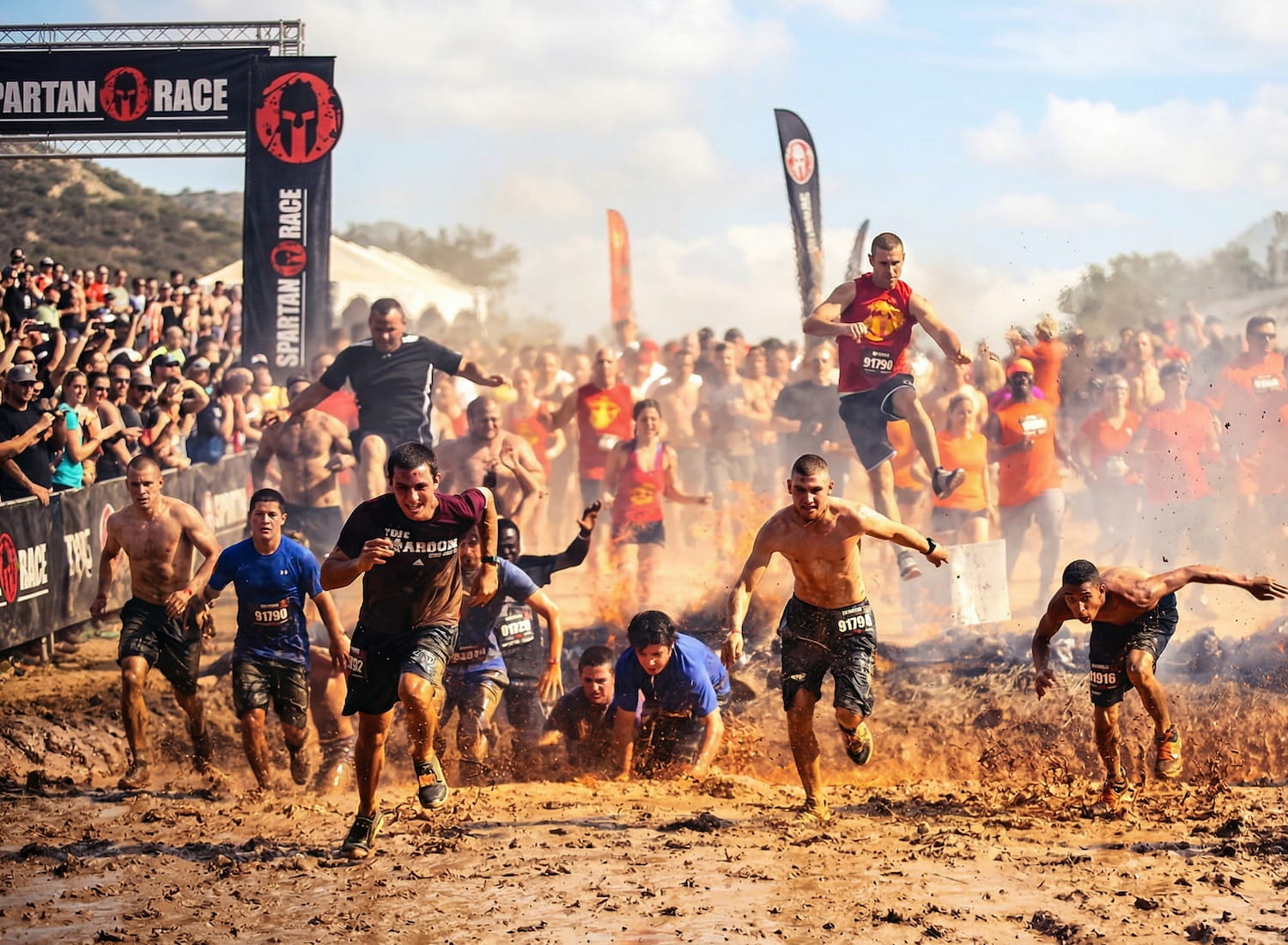
In Ancient Greece, the Spartans were revered for their physical and mental strength. The life of these soldiers began in childhood; weak infants had no place in military training. At age 7, boys entered the Agoge, a rigorous training regime that molded and transformed them into capable warriors who feared nothing. Their endurance tests included the flogging, a way to test these boys' bravery and pain tolerance.
Today, the ancient Spartan army serves as an inspiration to men and women seeking to improve their physical and mental fitness. The Spartan Race was created to test exactly that: “Spartans aren't soft. They overcome obstacles. And yes, Spartans do burpees.”
That's why we want to talk to you about how to train for a Spartan Race, and to that end we've prepared this downloadable infographic in PDF. Click the image or the following link to download the infographic:
30-Day Spartan Training Challenge for Obstacle Races
What is a Spartan Race?
Known as the best obstacle race in the world, the Spartan Race is a series of events that takes place around the world, from the U.S., Canada and Europe, to Australia and South Korea. The races vary in duration and difficulty, and range from 5km to marathon distances.
The Spartan Race is also a philosophy, a community, a training regimen and a nutrition program. It was founded by Joe De Sena, a global adventure racer, with the mission of creating an outdoor event that was as challenging as it was fun and that any active person could take part in.
What obstacles does the Spartan Race include?
A Spartan training plan should include much more than just running. Beyond running or walking, obstacle races include various barriers that competitors have to deal with. From strength exercises (carrying stones, carrying buckets filled with rocks, lifting weights, moving tires) and calisthenics (climbing ropes, scaling, jumping walls) to adrenaline-filled challenges that consist of crawling under barbed wire or jumping over fire.
Am I fit enough to finish a Spartan Race?
Spartans demonstrate their physical ability through actions, not words. Any active person who can do the above and is not afraid to get dirty, can prepare for a Spartan Race. Your experience in this obstacle race will be much more enjoyable if you have a certain level of fitness; you regularly do sports like running, fitness, CrossFit, hiking, calisthenics, etc.
The Spartan Race offers different levels and distances to choose from based on your mental and physical capabilities. So, how do you train and prepare for a Spartan Race?
Choose a goal: Types of Spartan Race
There are different types of Spartan Race to choose from. Most vary in distance and number of obstacles.
The Spartan Sprint is the shortest. The distance normally reaches 5km, which means it can extend up to 8km. The Spartan Sprint has more than 20 different obstacles. This race is suitable for rookies, people who haven't done an obstacle race before.
The Spartan Super is a race of over 12km with more than 25 obstacles. If you find the Sprint too short, the Super is a good option before you move on to longer courses.
The Spartan Beast is, as the name suggests, a harder version. With more than 20km and 30 obstacles, this race is appropriate for experienced Spartans. Besides the longer distance and more obstacles, the terrain is carefully selected to make the race even more challenging.
The Spartan Trifecta is a series of the three races mentioned above. After collecting the Sprint, Super and Beast medals within a calendar year, you become a member of the Trifecta tribe.
The Stadium Series are sprint races for Spartans who prefer to stay clean. These races have no muddy terrain in the football stadium. The Spartan Honor Series are races that take place on American military bases.
In addition to the typical Spartan Races, the company offers even more adventures and tough obstacles – endurance events. The Spartan Ultra Beast is not the typical competition. There are some terms and conditions you must accept before signing up for the event. The distance is twice that of the Beast: 41.8 km, which is the typical marathon distance. This race has more than 60 obstacles. As the name suggests, the race is appropriate only for extreme-level athletes. Another level of suffering is the Spartan Agoge, a 60-hour event.
If you prefer to run supported by your friends, you will probably like the Hurricane Heat, a team event. The hardest version lasts 12 hours.
What equipment do I need?
You're going to get wet and dirty, but for short distances, any sportswear is sufficient. Choose a more durable, so your clothes don't tear instantly. Gloves, even cheap gardening ones, will be a big help to protect your hands.
When it comes to footwear, choose shoes that are for trail or cross running, as they will give you good grip and secure your heels.
How to train and prepare for a Spartan Race?
Spartan Races are primarily endurance events, but that doesn't mean you only have to train by running. To be more efficient and able to overcome obstacles, having a certain level of strength and muscle mass is essential.
Spartan training should be a mix of endurance, strength, coordination and agility. While psychological attributes are definitely important, loving the outdoors and being willing to accept nuisances like dirt, moisture or changing weather matters even more.
Your preparation for the Spartan Race should be versatile. If you do CrossFit and your program includes running sessions, you're on a good path to comfortably finish a Spartan Sprint/Super.
Try fartlek or cross training
Running is important, but make sure you get out of the city and train outdoors — in the woods, countryside, or even the mountains — on different surfaces like dirt, sand or grass. A good way to train is fartlek, a mix of fast and slow running, usually done cross-style. If possible, find a mountain and do a good hike once a week.
Find a local obstacle course
Obstacle courses are a great way to get an idea of what the race will be of obstacles. Besides running, an obstacle course offers a series of stations with bars, jump obstacles, balance beams and more.
Be creative outdoors
When you go to the nearest woods, look for large stones and tree trunks that you can use as objects to move in your training. Pick them up and do sprint intervals (uphill).
Don't forget to train strength
Go to the gym at least twice a week and do basic strength exercises: squats, deadlifts, shoulder press, pull-ups, push-ups, dips… Add unilateral exercises such as single-leg deadlifts, dumbbell rows or kettlebell snatches.
Familiarize yourself with versatile movements
Besides running and lifting weights, Spartan Races include movements such as climbing, hanging, pushing and pulling/dragging. Try Primal training in addition to calisthenics. From time to time, visit a gym where you can climb.
Do burpees
You can't avoid burpees. Add them to your fartlek or outdoor training, or do a set of 50–100 after your strength session.
Whatever you do and however you prepare for a Spartan Race, don't neglect your recovery, rest, mobility and nutrition. “A successful Spartan is also a healthy Spartan.”