









The Sled Push is the second station of HYROX and one of the clearest separators between athletes who have trained and those who haven't.
It doesn't deceive you: it's pure applied strength. But if you arrive without technique, the sled stops halfway down the lane and what should be a quick station becomes a pit of time and energy that's hard to recover from.
In this guide you'll understand how the station works, which position to use, how not to waste a single step, and how to leave it with energy to keep running.
We've prepared a video on how to set up the Sled Push station and then we explain some key points in more detail and how you can access the full course at no cost, gifts, discounts and much more.
Let's break it down. First, the video on how to set up this station:
COMPETING IN DOUBLES?
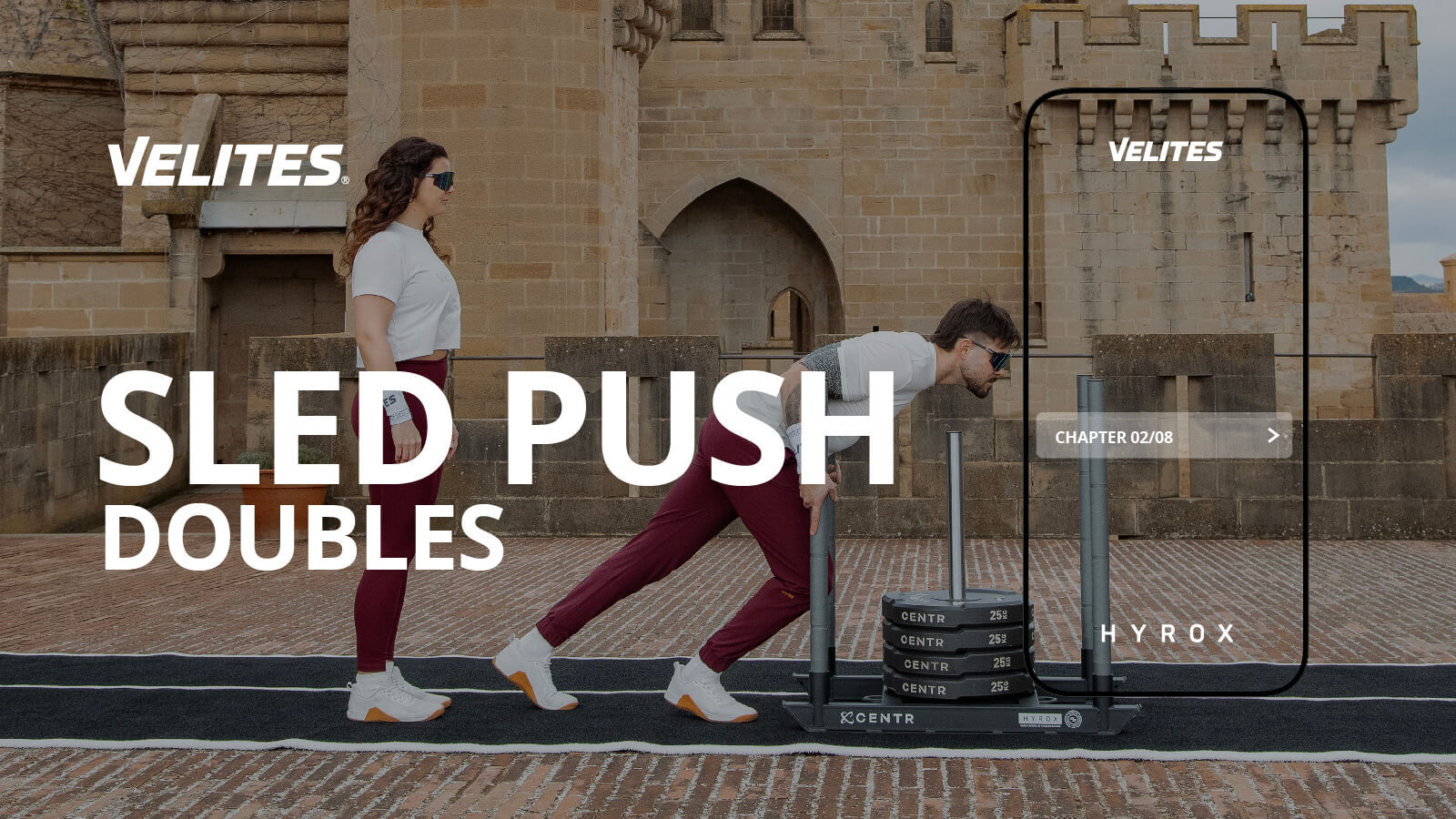
👉 If you're competing in doubles, don't miss this post that includes a video with the key points for this station in pairs format.
Velites is an international partner of HYROX, and we have developed specific resources for you to help you prepare for this competition: a complete video course with running technique and station-specific content, preparation for the pair competition, free access to our App with exclusive training plans, gifts, discounts and much more. Join and enjoy.

Also, if you want to train a specific HYROX station, here are the athlete guides we already have unlocked:
- HYROX Guide: Running
- HYROX Guide: SkiErg
- HYROX Guide: Sled Pull
- HYROX Guide: Burpee Broad Jumps
- HYROX Guide: Rowing
- HYROX Guide: Farmers Carry
- HYROX Guide: Sandbag Lunges
- HYROX Guide: Wall Balls
Want to train each station with technique, strategy and reference videos? Access the 8 Week Digital Training System; you have everything here on the blog, on YouTube and in the Velites Training App.
What is the Sled Push in HYROX?
The Sled Push is the second station of HYROX. It comes right after the second kilometer of running and consists of pushing a loaded sled along two 12.5-meter sections, completing a total of 25 meters per lap.
The movement involves the whole body: the quadriceps and glutes generate the force, the core transmits it, and the posterior chain completes the push. It is one of the most demanding stations in terms of absolute power.
And it has a feature that makes it especially brutal: if the sled stops, it takes twice the energy to get it moving again.
Why working the Sled Push makes you a better athlete
The Sled Push has no eccentric load, which means muscle damage is minimal compared to other strength exercises. You can train it frequently without paying a high recovery price.
Training it specifically improves:
- Posterior chain strength applied to horizontal movement
- The ability to maintain power under aerobic fatigue
- Running economy after a maximal effort
- Lactate tolerance in short, intense efforts
All of that transfers directly to performance in the other stations and in the running kilometers that follow.
Official distance and weight in HYROX
The distance is always the same across divisions: 25 total meters, divided into two 12.5-meter sections. The base sled weighs between 28 and 30 kg with the four posts, and plates are added depending on the category.
Weights by category:
| Women Open · Doubles Women · Women's Relays | 102kg |
| Men Open · Doubles Men · Doubles Mixed · Men's Relays · Pro Women · Pro Doubles Women | 152kg |
| Pro Men · Pro Doubles Men | 202kg |
| Mixed Relays |
F
102kg
M
152kg
|
Keep in mind that the surface has a big influence: the sled rolls differently on carpet, artificial turf or gym flooring. In competition, most venues use carpet or a staging platform, which increases resistance.
Official rules of the station
- The sled must fully cross the line before changing direction. If it doesn't, you'll have to push it back until it crosses.
- You cannot let go of the sled and rest during the push. The movement must be continuous or the sled will stop, which penalizes you in time and energy.
- The athlete must remain inside the assigned lane for the entire station.
- Enter through the IN and exit through the OUT of the Roxzone. Confusing them carries a 2-minute penalty per infraction.
- The lane and equipment are assigned by the judging team. You cannot choose.
Technique: the two efficient positions
There isn't a single correct way to push the sled. There are two main positions, and both work. What doesn't work is improvising in competition.
Arms-extended position
Hands above the center of the posts. Arms fully extended. Align wrist, elbow and shoulder in the same line.
Stay low, parallel to the ground. Transfer your weight into the sled and move with short, powerful steps.
This position works especially well for taller athletes or those with good horizontal pushing strength.
"Hug" position — the most common
Rest your forearms on the posts. Elbows tight. Use your hands as hooks, not as pushing points.
Keep the center of mass low, with the head and torso aligned with the center of the sled. Push with the legs while the shoulders follow the forward movement.
This position activates the posterior chain more and tends to be more efficient for shorter athletes or those with strong hip drive.
Both work. The important thing is to choose before you compete, not in the middle of the course.
The start: breaking inertia
The hardest moment of the Sled Push is the first one. The sled is stationary and it takes twice the energy to move it from zero.
The key is to use body weight: lean into the sled, activate the core and take the first steps explosively, as if you were starting a sprint. Don't push with your arms, push with your whole body.




Common mistakes to avoid
Force directed up or down
→ Drop your hands. The pressure has to go forward, not into the floor or the ceiling.
Steps that are too long
→ Short steps, pushing with the toes. Long steps lose traction and waste more energy.
Opening the elbows and pushing with the shoulders
→ Tuck the shoulders between the posts and keep the forearms tight. Open elbows disperse force and wear you out more.
Holding your breath
→ Breathe continuously: inhale and exhale fully. Holding your breath increases internal pressure and accelerates muscular fatigue.
Running strategy in the Sled Push
The Sled Push is 25 meters. It sounds short. It isn't.
Divide the course before starting. Use half the section as a mental reference. If you need more structure, count your steps: knowing how many you need to cover 12.5 meters helps you maintain rhythm without looking at the ground.
If the sled stops, stop completely, readjust your posture and restart with the first steps explosively.
The goal is to keep the sled moving constantly. Once it's rolling, it's much easier to maintain the pace than to start it again.
How to train the Sled Push for HYROX
- Train heavier than in competition: Working with more load than you'll see in the race makes the official weight feel manageable.
- Always combine sled training with running: Isolated Sled Push training doesn't prepare you for HYROX. Always include running before and after each sled block.
- Practice breathing under load: The habit must be automated for when you arrive at the race with a high heart rate.
- Reinforce the core with specific exercises: Planks, dead bugs and anti-rotation exercises have direct transfer.
Workout of the day
HYROX Sled Push Session
4 Rounds
400m Run at race pace
Sled Push 25m (competition weight or heavier)
Rest 1:30
Objective: Keep the sled moving each round. If it stops, readjust before pushing again. The prior run simulates real competition conditions.
More HYROX content
Our 8-week digital program includes:
- Technical videos for all stations
- Strategy for pairs
- Structured week-by-week programming
Velites is an international partner of HYROX, and we have developed specific resources for you to help you prepare for this competition: a complete video course with running technique and station-specific content, preparation for the pair competition, free access to our App with exclusive training plans, gifts, discounts and much more. Join and enjoy.